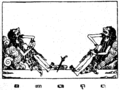
The Javanese alphabet itself forms a poem, and a perfect pangram, of which the line-by-line translation is as follows[2]:
Hana caraka There (were) two messengers
data sawala (They) had animosity (among each other)
padha jayanya (They were) equally powerful (in fight)
maga bathanga Here are the corpses.
in detail:
hana / ana = there were/was
caraka = messenger (actually, 'one who is loyal to and trusted by someone')
data = have/has
sawala = difference (regarding a matter)
padha = same, equal
jayanya = 'their power', 'jaya' could mean 'glory' as well
maga = 'here'
bathanga = corpses
caraka = messenger (actually, 'one who is loyal to and trusted by someone')
data = have/has
sawala = difference (regarding a matter)
padha = same, equal
jayanya = 'their power', 'jaya' could mean 'glory' as well
maga = 'here'
bathanga = corpses
-
Hana caraka (There were two messengers)
-
Data sawala (They had animosity)
-
Padha jayanya (They were equally powerful in fight)
-
Maga bathanga (Here are the corpses)


This story was told in the myth of Aji Saka, a Javanese mythology that tell the story about the came of civilization to Java, brought by legendary first king named Java Aji Saka, and the mythical story of Javanese script origin.[4]


 Posts


