Popular Posts

Showing posts with label poem. Show all posts

Thursday, 3 March 2022

Pablo Neruda: To the Foot From Its Child

Neruda

To the Foot From Its Child

A child's foot doesn't know it's a foot yet And it wants to be a butterfly or an apple But then the rocks and pieces of glass, the streets, the stairways and the roads of hard earth keep teaching the foot that it can't fly, that it can't be a round fruit on a branch. Then the child's foot was defeated, it fell in battle, it was a prisoner, condemned to life in a shoe.

Little by little without light it got acquainted with the world in its own way without knowing the other imprisoned foot exploring life like a blind man.

Those smooth toe nails of quartz in a bunch, got harder, they changed into an opaque substance, into hard horn and the child's little petals were crushed, lost their balance, took the form of a reptile without eyes, with triangular heads like a worm's. And they had callused over, they were covered with tiny lava fields of death, a hardening unasked for. But this blind thing kept going without surrender, without stopping hour after hour. One foot after another, now as a man, or a woman, above, below, through the fields, the mines, the stores, the government bureaus, backward, outside, inside, forward, this foot worked with its shoes, it hardly had time to be naked in love or in sleep one foot walked, both feet walked until the whole man stopped.

And then it went down into the earth and didn't know anything because there everything was dark, it didn't know it was no longer a foot or if they buried it so it could fly or so it could be an apple.

Saturday, 22 February 2014

'Football at Slack'


FOOTBALL AT SLACK

By Ted Hughes

Between plunging valleys, on a bareback of hill
Men in bunting colours
Bounced, and their blown ball bounced.
The blown ball jumped, and the merry - coloured men
Spouted like water to head it.
The ball blew away downward -
The rubbery men bounced after it.
The ball blew jumped up and out and hung on the wind
Over a gulf of treetops.
Then they all shouted together, and the ball blew back.
Winds from fiery holes in heaven
Piled the hills darkening around them
To awe them. The glare light
Mixed its mad oils and threw glooms.
Then the rain lowered a steel press.
Hair plastered, they all just trod water
To puddle glitter. And their shouts bobbed up
Coming fine and thin, washed and happy
While the humped world sank foundering
And the valleys blued unthinkable
Under depth of Atlantic depression -
But the wingers leapt, they bicycled in air
And the goalie flew horizontal
And once again a golden holocaust
Lifted the cloud's edge, to watch them.

From: Collected Poems of Ted Hughes, edited by Paul Keegan. London: Faber

'One Ordinary Evening'


Lying entwined with you
on the long sofa

the hi-fi helping
Isolde to her climax

I was clipping
the coarse hairs

from your ears
and ruby nostrils

when you said, “Music
for cutting nose wires”

and we shook so
the nail scissors nicked

your gentle neck
blood your blood

I cleansed the place
with my tongue

and we clung tight
pelted with Teutonic cries

till the player
lifted its little prick

from the groove
all arias over

leaving us
in post-Wagnerian sadness

later that year
you were dead

by your own hand
blood your blood

I have never understood
I will never understand.


Virginia Hamilton Adair

Thursday, 19 April 2012

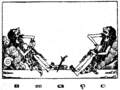
The Alphabet as Poem


The  Javanese alphabet itself forms a poem, and a perfect pangram, of which the line-by-line translation is as follows[2]:

Hana caraka There (were) two messengers
data sawala (They) had animosity (among each other)
padha jayanya (They were) equally powerful (in fight)
maga bathanga Here are the corpses.

in detail:
hana / ana = there were/was
caraka = messenger (actually, 'one who is loyal to and trusted by someone')
data = have/has
sawala = difference (regarding a matter)
padha = same, equal
jayanya = 'their power', 'jaya' could mean 'glory' as well
maga = 'here'
bathanga = corpses

This story was told in the myth of Aji Saka, a Javanese mythology that tell the story about the came of civilization to Java, brought by legendary first king named Java Aji Saka, and the mythical story of Javanese script origin.[4]


Wednesday, 18 April 2012

Marching Through a Novel: John Updike


            MARCHING THROUGH A NOVEL

                Each morning my characters
                   greet me with misty faces
                willing, though chilled, to muster
                   for another day's progress
                through the dazzling quicksand,
                   the marsh of blank paper.
                With instant obedience
                   they change clothes and mannerisms,
                drop a speech impediment,
                   develop a motive backwards
                to suit the deed that's done.  
                   They extend skeletal arms
                for the handcuffs of contrivance,
                    slog through docilely
                maneuvers of coincidence,
                    look toward me hopefully,
                 their general and quartermaster,
                    for a clearer face, a bigger heart.
                I do what I can for them,
                    but it is not enough.
                FORWARD is my order,
                    though their bandages unravel
                and some have no backbones
                    and some turn traitor
                like heads with two faces
                    and some fall forgotten
                in the trenchwork of loose threads,
                    poor puffs of cartoon flak.
                FORWARD. Believe me, I love them
                    though I march them to finish them off.

Friday, 30 July 2010

James Merill: Christmas tree


Not seasonal - nor is the snow bound picture of the Stevens' house below - but I came across this after reading the first chapter of Helen Vendler's Last looks, Last Books. The chapter is downloadable here, and worth the read.


To be
Brought down at last
From the cold sighing mountain
Where I and the others
Had been fed, looked after, kept still,
Meant, I knew--of course I knew--
That it would be only a matter of weeks,
That there was nothing more to do.
Warmly they took me in, made much of me,
The point from the start was to keep my spirits up.
I could assent to that. For honestly,
It did help to be wound in jewels, to send
Their colors flashing forth from vents in the deep
Fragrant sable that cloaked me head to foot.
Over me then they wove a spell of shining--
Purple and silver chains, eavesdripping tinsel,
Amulets, milagros: software of silver,
A heart, a little girl, a Model T,
Two staring eyes. The angels, trumpets, BUD and BEA
(The children's names) in clownlike capitals,
Somewhere a music box whose tiny song
Played and replayed I ended before long
By loving. And in shadow behind me, a primitive IV
To keep the show going. Yes, yes, what lay ahead
Was clear: the stripping, the cold street, my chemicals
Plowed back into Earth for lives to come--
No doubt a blessing, a harvest, but one that doesn't bear,
Now or ever, dwelling upon. To have grown so thin.
Needles and bone. The little boy's hands meeting
About my spine. The mother's voice: Holding up wonderfully!
No dread. No bitterness. The end beginning. Today's
Dusk room aglow
For the last time
With candlelight.
Faces love lit,
Gifts underfoot.
Still to be so poised, so
Receptive. Still to recall, to praise.

Wallace Stevens: The House was Quiet and the World was Calm


The house was quiet and the world was calm.
The reader became the book; and summer night

Was like the conscious being of the book.
The house was quiet and the world was calm.

The words were spoken as if there was no book,
Except that the reader leaned above the page,

Wanted to lean, wanted much to be
The scholar to whom his book is true, to whom

The summer night is like a perfection of thought.
The house was quiet because it had to be.

The quiet was part of the meaning, part of the mind:
The access of perfection to the page.

And the world was calm. The truth in a calm world,
In which there is no other meaning, itself

Is calm, itself is summer and night, itself
Is the reader leaning late and reading there.

Monday, 19 July 2010

Liverpool


This, from LRB: I'm not convinced that this string of epiphets does much to convey contemporary Liverpool, but it does evoke a Liverpool and it makes a tuneful litany

Epithets

Jamie Mackendrick

Toledo la rica, Salamanca la fuerte, León la bella, Oviedo la sacra, y Sevilla la grande.

Liverpool the impoverished, the liverish, the void, the full,
the self-besotted, the blarney-argoted, the blitzed and blackened,
the bella-brutta, the rag-rich, the moss-stained sandstoned,
the green-lung’d, the ricket-ridden, the loud and adenoidal.

Liverpool the last-to-be-served, the least-accounted,
the over-arched and undermined, the mother-tongued and plurilingual,
the Catholic-Protestant, the cap-in-hand, the hand-
to-mouth, the pub-encrusted and the hovel-haunted.

Liverpool the riverine, the ocean-avid, the slaveship-tainted,
sugar-whitening, matchstick-making, slum and dockland
refuge of Lascars, Chinese, Irish, Jews, Somalians.

Liverpool the deserted, the polluted, the de bon aire,
the clinker-built and shipwrecked, the chameleon,
the edge-of-everywhere-and-nowhere’s-centre.

Wednesday, 9 June 2010

Billy Collins: The Quaintness of the Past


The Quaintness of the Past

Click the arrow on the audio player to hear Billy Collins read this poem. You can also download the recording or subscribe to Slate's Poetry Podcast on iTunes.


.

I turn the page of a magazine
and find a black-and-white photograph
of a roadhouse taken in the 1950s,
an old clapboard affair
with a car of that vintage,
maybe a Plymouth, parked in front.

It is almost enough to inspire me
to take a snapshot of something around here
first thing in the morning,
maybe the little bakery down the street
where I often go for coffee and a muffin
and the big city paper
and the French girls behind the counter.

Ideally there would be a few modern cars
parked in front,
then all I would have to do
is walk back home and wait 50 or 100 years
for the photograph to become a thing of interest and value.

Of course, I will be long gone by then
and time will have marched on,
though I never think of time as marching
down a football field blowing a trumpet
or into a city square
with a rifle on its shoulder.

I picture time advancing more slowly
up a mountain, leaving
all the moments of history behind
like climbers who have to leave behind
one of their companions on a cold glacial slope.

And sometimes, decades later,
the body is discovered,
the ice is chipped away, and we get to see
a photograph of the remains—
the bones of the hands arthritically
fisted up, the jaw locked tight,
a skull wearing a woolen cap,
the man quaintly smiling out at us from the past
before we wet a finger and turn the page.

Sunday, 7 March 2010

Frank O'Hara/ Anne Carson/Vladimir Mayakovsky


Because A True Account of Talking to the Sun at Fire Island by Frank O’Hara is one of my favourite poems, and because Anne Carson in the LRB has written a response to it.

The Sun woke me this morning loud
and clear, saying "Hey! I've been
trying to wake you up for fifteen
minutes. Don't be so rude, you are
only the second poet I've ever chosen
to speak to personally
so why
aren't you more attentive? If I could
burn you through the window I would
to wake you up. I can't hang around
here all day."
"Sorry, Sun, I stayed
up late last night talking to Hal."

"When I woke up Mayakovsky he was
a lot more prompt" the Sun said
petulantly. "Most people are up
already waiting to see if I'm going
to put in an appearance."
I tried
to apologize "I missed you yesterday."
"That's better" he said. "I didn't
know you'd come out." "You may be wondering why I've come so close?"
"Yes" I said beginning to feel hot
and wondering if maybe he wasn't burning me
anyway.
"Frankly I wanted to tell you
I like your poetry. I see a lot
on my rounds and you're okay. You may
not be the greatest thing on earth, but
you're different. Now, I've heard some
say you're crazy, they being excessively
calm themselves to my mind, and other
crazy poets think that you're a boring
reactionary. Not me.
Just keep on
like I do and pay no attention. You'll
find that some people always will
complain about the atmosphere,
either too hot
or too cold too bright or too dark, days
too short or too long.
If you don't appear
at all one day they think you're lazy
or dead. Just keep right on, I like it.

And don't worry about your lineage
poetic or natural. The Sun shines on
the jungle, you know, on the tundra
the sea, the ghetto. Wherever you were
I knew it and saw you moving. I was waiting
for you to get to work.

And now that you
are making your own days, so to speak,
even if no one reads you but me
you won't be depressed. Not
everyone can look up, even at me. It
hurts their eyes."
"Oh Sun, I'm so grateful to you!"

"Thanks and remember I'm watching. It's
easier for me to speak to you out
here. I don't have to slide down
between buildings to get your ear.
I know you love Manhattan, but
you ought to look up more often.
And
always embrace things, people earth
sky stars, as I do, freely and with
the appropriate sense of space. That
is your inclination, known in the heavens
and you should follow it to hell, if
necessary, which I doubt.
Maybe we'll
speak again in Africa, of which I too
am specially fond. Go back to sleep now
Frank, and I may leave a tiny poem
in that brain of yours as my farewell."

"Sun, don't go!" I was awake
at last. "No, go I must, they're calling
me."
"Who are they?"
Rising he said "Some
day you'll know. They're calling to you
too." Darkly he rose, and then I slept.


And here is Good Dog by Anne Carson

I was waiting for you to get to work
‘A True Account of Talking to the Sun at Fire Island’
Frank O’Hara

1 You know the second person in the history of the world
the Sun chose to speak to personally was Frank O’Hara, the
first was Orpheus [me]. You are my Sweetheart said the
Sun. He was sitting on the hood of his truck. Somehow it
was menacing. I hardly knew what to say. I got into the
truck that strange autumn light sharpening all glass and
harm my hands fell off. The Sun got in beside me took my
hands one by one blew into each finger filling it with a
kind of sound. Gave my hands back to me. That was the
beginning of my being interesting

2 I had originally an idea to record the sound of skirts
moving on legs on the runway this blank verse. She was a
model when I first of course no one runs on a runway
but the skirts the legs are like pumas. Desire she said is not
harmful til lips spill it then be careful

3 Tell you a story about the best poem I ever wrote the one I
lost. That page was terrific it slid out of a dream about the
littorals above Europe and me looking down as. As on oh
oceans I had all the answers I was an answer! I was high as
day arising and truth shot out of me like a lark. Years ago.
These are tears I do not use. I lost the page again and again
found it again and again every time I moved finally
captured it in a plastic sleeve put it on top of the TV. A
scrap of paper torn and brownish now some words just
stain. What does it mean the littorals above Europe I never
found out. I look at it fast sometimes Hoping

4 Like any couple we’d sat silent in restaurants staring
opposite ways our pockets stuffed with useless summer
money doesn’t mean we were a pissed palindrome

5 Like any couple don’t whistle I’m not your good dog she’d
say I’d say swimming at this hour you must be mad

6 My fifteen minutes in hell I scarcely remember. I know it
was cold. I saw uncreated things seeping here and there
with roots for ears they hadn’t heard a voice in centuries. I
sang a bit. The very ghosts shed tears (Daily Mirror). Eurydice
limped over. Lawyers arrived reciting conditions. Soon
we were off down the hall me admiring the acoustics
wondering could I get a gig and What’s the phone number
down here I said starting to turn poof shall we say a sad
mischance. All my skin cried back all my wings beat once
and that was that. The story that she said nothing but Who?
is a lie

7 One thing about hell is the echo is fabulous. No sound
studio on earth can give you a transverse magnetisation
leak of less than zero. I stood in the black trees transfixed
and pulsing and her stroking off down the lake so strangely
slow

8 I was. I lost. I sang. I knew. I ever hope for that strange
autumn light again with the good dog again with the
thousands of years. Scrap of [me] off Eurydice torn. Her
number I lost her lark I shot and she a pulse. History never
looks so possible as when leaving a heart spilt among the
stones crying Don’t read it again it was perfect

The illustration for the Anne Carson poem is really a drawing of Anna Ahkmatova but its a nice connection to the poem that begat both the O'Hara and the Carson poem

An Extraordinary Adventure Which Befell Vladimir Mayakovksy In A Summer Cottage
Vladimir Mayakovsky

A hundred and forty suns in one sunset blazed,
and summer rolled into July;
it was so hot,
the heat swam in a haze—
and this was in the country.
Pushkino, a hillock, had for hump
Akula, a large hill,
and at the hill’s foot
a village stood—
crooked with the crust of roofs.
Beyond the village
gaped a hole
and into that hole, most likely,
the sun sank down each time,
faithfully and slowly.
And next morning,
to flood the world
anew,
the sun would rise all scarlet.
Day after day
this very thing
began
to rouse in me
great anger.
And flying into such a rage one day
that all things paled with fear,
I yelled at the sun point-blank:
“Get down!
Stop crawling into that hellhole!”
At the sun I yelled:
“You shiftless lump!
You’re caressed by the clouds,
while here—winter and summer—
I must sit and draw these posters!”
I yelled at the sun again:
“Wait now!
Listen, goldbrow,
instead of going down,
why not come down to tea
with me!”
What have I done!
I’m finished!
Toward me, of his own good will,
himself,
spreading his beaming steps,
the sun strode across the field.
I tried to hide my fear,
and beat it backwards.
His eyes were in the garden now.
Then he passed through the garden.
His sun’s mass pressing
through the windows,
doors,
and crannies;
in he rolled;
drawing a breath,
he spoke deep bass:
“For the first time since creation,
I drive the fires back.
You called me?
Give me tea, poet,
spread out, spread out the jam!”
Tears gathered in my eyes—
the heat was maddening,
but pointing to the samovar
I said to him:
“Well, sit down then,
luminary!”
The devil had prompted my insolence
to shout at him,
confused—
I sat on the edge of a bench;
I was afraid of worse!
But, from the sun, a strange radiance
streamed,
and forgetting
all formalities,
I sat chatting
with the luminary more freely.
Of this
and that I talked,
and of how I was swallowed up by Rosta,
but the sun, he says:
All right,
don’t worry,
look at things more simply!
And do you think
I find it easy
to shine?
Just try it, if you will!—
You move along,
since move you must;
you move—and shine your eyes out!”
We gossiped thus till dark—
Till former night, I mean.
For what darkness was there here?
We warmed up
to each other
and very soon,
openly displaying friendship,
I slapped him on the back.
The sun responded!
“You and I,
my comrade, are quite a pair!
Let’s go, my poet,
let’s dawn
and sing
in a gray tattered world.
I shall pour forth my sun,
and you—your own,
in verse.”
A wall of shadows,
a jail of nights
fell under the double-barreled suns.
A commotion of verse and light—
shine all your worth!
Drowsy and dull,
one tired,
wanting to stretch out
for the night.
Suddenly—I
shone in all my might,
and morning ran its round.
Always to shine,
to shine everywhere,
to the very deeps of the last days,
to shine—
and to hell with everything else!
That is my motto—
and the sun’s!

Ten Rules for Writing


The Guardian's !0 Rules for Writers is proving very popular and the article as a whole is thought-provoking as to the mechanics of writing and to the psychology of the writer.

It is good to note that there is some awareness that it is a commercial endeavour deeply determined by industrial practices and not simply rules for a mad solipsistic existence in a garret. Far less occasionally is there an attempt to define what future there is in the form itself (the contributors are mainly novelists) or in printed book itself, but that's a great deal to expect of an article that doesn't depart from the notion of a writer as presented by Roland Barthes in his Mythologies essay, The Writer on Holiday, but there is inspiration aplenty here and that was the article's main intention.


Elmore Leonard: Using adverbs is a mortal sin

1 Never open a book with weather. If it's only to create atmosphere, and not a charac­ter's reaction to the weather, you don't want to go on too long. The reader is apt to leaf ahead look­ing for people. There are exceptions. If you happen to be Barry Lopez, who has more ways than an Eskimo to describe ice and snow in his book Arctic Dreams, you can do all the weather reporting you want.

2 Avoid prologues: they can be ­annoying, especially a prologue ­following an introduction that comes after a foreword. But these are ordinarily found in non-fiction. A prologue in a novel is backstory, and you can drop it in anywhere you want. There is a prologue in John Steinbeck's Sweet Thursday, but it's OK because a character in the book makes the point of what my rules are all about. He says: "I like a lot of talk in a book and I don't like to have nobody tell me what the guy that's talking looks like. I want to figure out what he looks like from the way he talks."

3 Never use a verb other than "said" to carry dialogue. The line of dialogue belongs to the character; the verb is the writer sticking his nose in. But "said" is far less intrusive than "grumbled", "gasped", "cautioned", "lied". I once noticed Mary McCarthy ending a line of dialogue with "she asseverated" and had to stop reading and go to the dictionary.

4 Never use an adverb to modify the verb "said" . . . he admonished gravely. To use an adverb this way (or almost any way) is a mortal sin. The writer is now exposing himself in earnest, using a word that distracts and can interrupt the rhythm of the exchange. I have a character in one of my books tell how she used to write historical romances "full of rape and adverbs".

5 Keep your exclamation points ­under control. You are allowed no more than two or three per 100,000 words of prose. If you have the knack of playing with exclaimers the way Tom Wolfe does, you can throw them in by the handful.

6 Never use the words "suddenly" or "all hell broke loose". This rule doesn't require an explanation. I have noticed that writers who use "suddenly" tend to exercise less control in the application of exclamation points.

7 Use regional dialect, patois, sparingly. Once you start spelling words in dialogue phonetically and loading the page with apos­trophes, you won't be able to stop. Notice the way Annie Proulx captures the flavour of Wyoming voices in her book of short stories Close Range.

8 Avoid detailed descriptions of characters, which Steinbeck covered. In Ernest Hemingway's "Hills Like White Elephants", what do the "Ameri­can and the girl with him" look like? "She had taken off her hat and put it on the table." That's the only reference to a physical description in the story.

9 Don't go into great detail describing places and things, unless you're ­Margaret Atwood and can paint scenes with language. You don't want descriptions that bring the action, the flow of the story, to a standstill.

10 Try to leave out the part that readers tend to skip. Think of what you skip reading a novel: thick paragraphs of prose you can see have too many words in them.

My most important rule is one that sums up the 10: if it sounds like writing, I rewrite it.

Elmore Leonard's 10 Rules of Writing is published next month by Weidenfeld & Nicolson.

Diana Athill

1 Read it aloud to yourself because that's the only way to be sure the rhythms of the sentences are OK (prose rhythms are too complex and subtle to be thought out – they can be got right only by ear).

2 Cut (perhaps that should be CUT): only by having no ­inessential words can every essential word be made to count.

3 You don't always have to go so far as to murder your darlings – those turns of phrase or images of which you felt extra proud when they appeared on the page – but go back and look at them with a very beady eye. Almost always it turns out that they'd be better dead. (Not every little twinge of satisfaction is suspect – it's the ones which amount to a sort of smug glee you must watch out for.)

Margaret Atwood

1 Take a pencil to write with on aeroplanes. Pens leak. But if the pencil breaks, you can't sharpen it on the plane, because you can't take knives with you. Therefore: take two pencils.

2 If both pencils break, you can do a rough sharpening job with a nail file of the metal or glass type.

3 Take something to write on. Paper is good. In a pinch, pieces of wood or your arm will do.

4 If you're using a computer, always safeguard new text with a ­memory stick.

5 Do back exercises. Pain is distracting.

6 Hold the reader's attention. (This is likely to work better if you can hold your own.) But you don't know who the reader is, so it's like shooting fish with a slingshot in the dark. What ­fascinates A will bore the pants off B.

7 You most likely need a thesaurus, a rudimentary grammar book, and a grip on reality. This latter means: there's no free lunch. Writing is work. It's also gambling. You don't get a pension plan. Other people can help you a bit, but ­essentially you're on your own. ­Nobody is making you do this: you chose it, so don't whine.

8 You can never read your own book with the innocent anticipation that comes with that first delicious page of a new book, because you wrote the thing. You've been backstage. You've seen how the rabbits were smuggled into the hat. Therefore ask a reading friend or two to look at it before you give it to anyone in the publishing business. This friend should not be someone with whom you have a ­romantic relationship, unless you want to break up.

9 Don't sit down in the middle of the woods. If you're lost in the plot or blocked, retrace your steps to where you went wrong. Then take the other road. And/or change the person. Change the tense. Change the opening page.

10 Prayer might work. Or reading ­something else. Or a constant visual­isation of the holy grail that is the finished, published version of your resplendent book.

Roddy Doyle

1 Do not place a photograph of your ­favourite author on your desk, especially if the author is one of the famous ones who committed suicide.

2 Do be kind to yourself. Fill pages as quickly as possible; double space, or write on every second line. Regard every new page as a small triumph ­–

3 Until you get to Page 50. Then calm down, and start worrying about the quality. Do feel anxiety – it's the job.

4 Do give the work a name as quickly as possible. Own it, and see it. Dickens knew Bleak House was going to be called Bleak House before he started writing it. The rest must have been easy.

5 Do restrict your browsing to a few websites a day. Don't go near the online bookies – unless it's research.

6 Do keep a thesaurus, but in the shed at the back of the garden or behind the fridge, somewhere that demands travel or effort. Chances are the words that come into your head will do fine, eg "horse", "ran", "said".

7 Do, occasionally, give in to temptation. Wash the kitchen floor, hang out the washing. It's research.

8 Do change your mind. Good ideas are often murdered by better ones. I was working on a novel about a band called the Partitions. Then I decided to call them the Commitments.

9 Do not search amazon.co.uk for the book you haven't written yet.

10 Do spend a few minutes a day working on the cover biog – "He divides his time between Kabul and Tierra del Fuego." But then get back to work.

Helen Dunmore

1 Finish the day's writing when you still want to continue.

2 Listen to what you have written. A dud rhythm in a passage of dialogue may show that you don't yet understand the characters well enough to write in their voices.

3 Read Keats's letters.

4 Reread, rewrite, reread, rewrite. If it still doesn't work, throw it away. It's a nice feeling, and you don't want to be cluttered with the corpses of poems and stories which have everything in them except the life they need.

5 Learn poems by heart.

6 Join professional organisations which advance the collective rights of authors.

7 A problem with a piece of writing often clarifies itself if you go for a long walk.

8 If you fear that taking care of your children and household will damage your writing, think of JG Ballard.

9 Don't worry about posterity – as Larkin (no sentimentalist) observed "What will survive of us is love".

Geoff Dyer

1 Never worry about the commercial possibilities of a project. That stuff is for agents and editors to fret over – or not. Conversation with my American publisher. Me: "I'm writing a book so boring, of such limited commercial appeal, that if you publish it, it will probably cost you your job." Publisher: "That's exactly what makes me want to stay in my job."

2 Don't write in public places. In the early 1990s I went to live in Paris. The usual writerly reasons: back then, if you were caught writing in a pub in England, you could get your head kicked in, whereas in Paris, dans les cafés . . . Since then I've developed an aversion to writing in public. I now think it should be done only in private, like any other lavatorial activity.

3 Don't be one of those writers who sentence themselves to a lifetime of sucking up to Nabokov.

4 If you use a computer, constantly refine and expand your autocorrect settings. The only reason I stay loyal to my piece-of-shit computer is that I have invested so much ingenuity into building one of the great auto­correct files in literary history. Perfectly formed and spelt words emerge from a few brief keystrokes: "Niet" becomes "Nietzsche", "phoy" becomes ­"photography" and so on. ­Genius!

5 Keep a diary. The biggest regret of my writing life is that I have never kept a journal or a diary.

6 Have regrets. They are fuel. On the page they flare into desire.

7 Have more than one idea on the go at any one time. If it's a choice between writing a book and doing nothing I will always choose the latter. It's only if I have an idea for two books that I choose one rather than the other. I ­always have to feel that I'm bunking off from something.

8 Beware of clichés. Not just the ­clichés that Martin Amis is at war with. There are clichés of response as well as expression. There are clichés of observation and of thought – even of conception. Many novels, even quite a few adequately written ones, are ­clichés of form which conform to clichés of expectation.

9 Do it every day. Make a habit of putting your observations into words and gradually this will become instinct. This is the most important rule of all and, naturally, I don't follow it.

10 Never ride a bike with the brakes on. If something is proving too difficult, give up and do something else. Try to live without resort to per­severance. But writing is all about ­perseverance. You've got to stick at it. In my 30s I used to go to the gym even though I hated it. The purpose of ­going to the gym was to postpone the day when I would stop going. That's what writing is to me: a way of ­postponing the day when I won't do it any more, the day when I will sink into a depression so profound it will be indistinguishable from perfect bliss.

Anne Enright

1 The first 12 years are the worst.

2 The way to write a book is to actually write a book. A pen is useful, typing is also good. Keep putting words on the page.

3 Only bad writers think that their work is really good.

4 Description is hard. Remember that all description is an opinion about the world. Find a place to stand.

5 Write whatever way you like. Fiction is made of words on a page; reality is made of something else. It doesn't matter how "real" your story is, or how "made up": what matters is its necessity.

6 Try to be accurate about stuff.

7 Imagine that you are dying. If you had a terminal disease would you ­finish this book? Why not? The thing that annoys this 10-weeks-to-live self is the thing that is wrong with the book. So change it. Stop arguing with yourself. Change it. See? Easy. And no one had to die.

8 You can also do all that with whiskey.

9 Have fun.

10 Remember, if you sit at your desk for 15 or 20 years, every day, not ­counting weekends, it changes you. It just does. It may not improve your temper, but it fixes something else. It makes you more free.

Richard Ford

1 Marry somebody you love and who thinks you being a writer's a good idea.

2 Don't have children.

3 Don't read your reviews.

4 Don't write reviews. (Your judgment's always tainted.)

5 Don't have arguments with your wife in the morning, or late at night.

6 Don't drink and write at the same time.

7 Don't write letters to the editor. (No one cares.)

8 Don't wish ill on your colleagues.

9 Try to think of others' good luck as encouragement to yourself.

10 Don't take any shit if you can ­possibly help it.

Jonathan Franzen

1 The reader is a friend, not an adversary, not a spectator.

2 Fiction that isn't an author's personal adventure into the frightening or the unknown isn't worth writing for anything but money.

3 Never use the word "then" as a ­conjunction – we have "and" for this purpose. Substituting "then" is the lazy or tone-deaf writer's non-solution to the problem of too many "ands" on the page.

4 Write in the third person unless a ­really distinctive first-person voice ­offers itself irresistibly.

5 When information becomes free and universally accessible, voluminous research for a novel is devalued along with it.

6 The most purely autobiographical ­fiction requires pure invention. Nobody ever wrote a more auto­biographical story than "The Meta­morphosis".

7 You see more sitting still than chasing after.

8 It's doubtful that anyone with an internet connection at his workplace is writing good fiction.

9 Interesting verbs are seldom very interesting.

10 You have to love before you can be relentless.

Esther Freud

1 Cut out the metaphors and similes. In my first book I promised myself I wouldn't use any and I slipped up ­during a sunset in chapter 11. I still blush when I come across it.

2 A story needs rhythm. Read it aloud to yourself. If it doesn't spin a bit of magic, it's missing something.

3 Editing is everything. Cut until you can cut no more. What is left often springs into life.

4 Find your best time of the day for writing and write. Don't let anything else interfere. Afterwards it won't matter to you that the kitchen is a mess.

5 Don't wait for inspiration. Discipline is the key.

6 Trust your reader. Not everything needs to be explained. If you really know something, and breathe life into it, they'll know it too.

7 Never forget, even your own rules are there to be broken.

Neil Gaiman

1 Write.

2 Put one word after another. Find the right word, put it down.

3 Finish what you're writing. Whatever you have to do to finish it, finish it.

4 Put it aside. Read it pretending you've never read it before. Show it to friends whose opinion you respect and who like the kind of thing that this is.

5 Remember: when people tell you something's wrong or doesn't work for them, they are almost always right. When they tell you exactly what they think is wrong and how to fix it, they are almost always wrong.

6 Fix it. Remember that, sooner or later, before it ever reaches perfection, you will have to let it go and move on and start to write the next thing. Perfection is like chasing the horizon. Keep moving.

7 Laugh at your own jokes.

8 The main rule of writing is that if you do it with enough assurance and confidence, you're allowed to do whatever you like. (That may be a rule for life as well as for writing. But it's definitely true for writing.) So write your story as it needs to be written. Write it ­honestly, and tell it as best you can. I'm not sure that there are any other rules. Not ones that matter.

David Hare

1 Write only when you have something to say.

2 Never take advice from anyone with no investment in the outcome.

3 Style is the art of getting yourself out of the way, not putting yourself in it.

4 If nobody will put your play on, put it on yourself.

5 Jokes are like hands and feet for a painter. They may not be what you want to end up doing but you have to master them in the meanwhile.

6 Theatre primarily belongs to the young.

7 No one has ever achieved consistency as a screenwriter.

8 Never go to a TV personality festival masquerading as a literary festival.

9 Never complain of being misunderstood. You can choose to be understood, or you can choose not to.

10 The two most depressing words in the English language are "literary fiction".

PD James

1 Increase your word power. Words are the raw material of our craft. The greater your vocabulary the more ­effective your writing. We who write in English are fortunate to have the richest and most versatile language in the world. Respect it.

2 Read widely and with discrimination. Bad writing is contagious.

3 Don't just plan to write – write. It is only by writing, not dreaming about it, that we develop our own style.

4 Write what you need to write, not what is currently popular or what you think will sell.

5 Open your mind to new experiences, particularly to the study of other ­people. Nothing that happens to a writer – however happy, however tragic – is ever wasted.

AL Kennedy

1 Have humility. Older/more ­experienced/more convincing writers may offer rules and varieties of advice. ­Consider what they say. However, don't automatically give them charge of your brain, or anything else – they might be bitter, twisted, burned-out, manipulative, or just not very like you.

2 Have more humility. Remember you don't know the limits of your own abilities. Successful or not, if you keep pushing beyond yourself, you will enrich your own life – and maybe even please a few strangers.

3 Defend others. You can, of course, steal stories and attributes from family and friends, fill in filecards after lovemaking and so forth. It might be better to celebrate those you love – and love itself – by writing in such a way that everyone keeps their privacy and dignity intact.

4 Defend your work. Organisations, institutions and individuals will often think they know best about your work – especially if they are paying you. When you genuinely believe their decisions would damage your work – walk away. Run away. The money doesn't matter that much.

5 Defend yourself. Find out what keeps you happy, motivated and creative.

6 Write. No amount of self-inflicted misery, altered states, black pullovers or being publicly obnoxious will ever add up to your being a writer. Writers write. On you go.

7 Read. As much as you can. As deeply and widely and nourishingly and ­irritatingly as you can. And the good things will make you remember them, so you won't need to take notes.

8 Be without fear. This is impossible, but let the small fears drive your rewriting and set aside the large ones ­until they behave – then use them, maybe even write them. Too much fear and all you'll get is silence.

9 Remember you love writing. It wouldn't be worth it if you didn't. If the love fades, do what you need to and get it back.

10 Remember writing doesn't love you. It doesn't care. Nevertheless, it can behave with remarkable generosity. Speak well of it, encourage others, pass it on.

Hilary Mantel

1 Are you serious about this? Then get an accountant.

2 Read Becoming a Writer, by Dorothea Brande. Then do what it says, including the tasks you think are impossible. You will particularly hate the advice to write first thing in the morning, but if you can manage it, it might well be the best thing you ever do for yourself. This book is about becoming a writer from the inside out. Many later advice manuals derive from it. You don't ­really need any others, though if you want to boost your confidence, "how to" books seldom do any harm. You can kick-start a whole book with some little writing exercise.

3 Write a book you'd like to read. If you wouldn't read it, why would anybody else? Don't write for a perceived audience or market. It may well have vanished by the time your book's ready.

4 If you have a good story idea, don't assume it must form a prose narrative. It may work better as a play, a screenplay or a poem. Be flexible.

5 Be aware that anything that appears before "Chapter One" may be skipped. Don't put your vital clue there.

6 First paragraphs can often be struck out. Are you performing a haka, or just shuffling your feet?

7 Concentrate your narrative energy on the point of change. This is especially important for historical fiction. When your character is new to a place, or things alter around them, that's the point to step back and fill in the details of their world. People don't notice their everyday surroundings and daily routine, so when writers describe them it can sound as if they're trying too hard to instruct the reader.

8 Description must work for its place. It can't be simply ornamental. It ­usually works best if it has a human element; it is more effective if it comes from an implied viewpoint, rather than from the eye of God. If description is coloured by the viewpoint of the character who is doing the noticing, it becomes, in effect, part of character definition and part of the action.

9 If you get stuck, get away from your desk. Take a walk, take a bath, go to sleep, make a pie, draw, listen to ­music, meditate, exercise; whatever you do, don't just stick there scowling at the problem. But don't make telephone calls or go to a party; if you do, other people's words will pour in where your lost words should be. Open a gap for them, create a space. Be patient.

10 Be ready for anything. Each new story has different demands and may throw up reasons to break these and all other rules. Except number one: you can't give your soul to literature if you're thinking about income tax.

Michael Moorcock

1 My first rule was given to me by TH White, author of The Sword in the Stone and other Arthurian fantasies and was: Read. Read everything you can lay hands on. I always advise people who want to write a fantasy or science fiction or romance to stop reading everything in those genres and start reading everything else from Bunyan to Byatt.

2 Find an author you admire (mine was Conrad) and copy their plots and characters in order to tell your own story, just as people learn to draw and paint by copying the masters.

3 Introduce your main characters and themes in the first third of your novel.

4 If you are writing a plot-driven genre novel make sure all your major themes/plot elements are introduced in the first third, which you can call the introduction.

5 Develop your themes and characters in your second third, the development.

6 Resolve your themes, mysteries and so on in the final third, the resolution.

7 For a good melodrama study the famous "Lester Dent master plot formula" which you can find online. It was written to show how to write a short story for the pulps, but can be adapted successfully for most stories of any length or genre.

8 If possible have something going on while you have your characters delivering exposition or philosophising. This helps retain dramatic tension.

9 Carrot and stick – have protagonists pursued (by an obsession or a villain) and pursuing (idea, object, person, mystery).

10 Ignore all proferred rules and create your own, suitable for what you want to say.

Michael Morpurgo

1 The prerequisite for me is to keep my well of ideas full. This means living as full and varied a life as possible, to have my antennae out all the time.

2 Ted Hughes gave me this advice and it works wonders: record moments, fleeting impressions, overheard dialogue, your own sadnesses and bewilderments and joys.

3 A notion for a story is for me a confluence of real events, historical perhaps, or from my own memory to create an exciting fusion.

4 It is the gestation time which counts.

5 Once the skeleton of the story is ready I begin talking about it, mostly to Clare, my wife, sounding her out.

6 By the time I sit down and face the blank page I am raring to go. I tell it as if I'm talking to my best friend or one of my grandchildren.

7 Once a chapter is scribbled down rough – I write very small so I don't have to turn the page and face the next empty one – Clare puts it on the word processor, prints it out, sometimes with her own comments added.

8 When I'm deep inside a story, ­living it as I write, I honestly don't know what will happen. I try not to dictate it, not to play God.

9 Once the book is finished in its first draft, I read it out loud to myself. How it sounds is hugely important.

10 With all editing, no matter how sensitive – and I've been very lucky here – I react sulkily at first, but then I settle down and get on with it, and a year later I have my book in my hand.

Andrew Motion

1 Decide when in the day (or night) it best suits you to write, and organise your life accordingly.

2 Think with your senses as well as your brain.

3 Honour the miraculousness of the ordinary.

4 Lock different characters/elements in a room and tell them to get on.

5 Remember there is no such thing as nonsense.

6 Bear in mind Wilde's dictum that "only mediocrities develop" – and ­challenge it.

7 Let your work stand before deciding whether or not to serve.

8 Think big and stay particular.

9 Write for tomorrow, not for today.

10 Work hard.

Joyce Carol Oates

1 Don't try to anticipate an "ideal reader" – there may be one, but he/she is reading someone else.

2 Don't try to anticipate an "ideal reader" – except for yourself perhaps, sometime in the future.

3 Be your own editor/critic. Sympathetic but merciless!

4 Unless you are writing something very avant-garde – all gnarled, snarled and "obscure" – be alert for possibilities of paragraphing.

5 Unless you are writing something very post-modernist – self-conscious, self-reflexive and "provocative" – be alert for possibilities of using plain familiar words in place of polysyllabic "big" words.

6 Keep in mind Oscar Wilde: "A little sincerity is a dangerous thing, and a great deal of it is absolutely fatal."

7 Keep a light, hopeful heart. But ­expect the worst.

Annie Proulx

1 Proceed slowly and take care.

2 To ensure that you proceed slowly, write by hand.

3 Write slowly and by hand only about subjects that interest you.

4 Develop craftsmanship through years of wide reading.

5 Rewrite and edit until you achieve the most felicitous phrase/sentence/paragraph/page/story/chapter.

Philip Pullman

My main rule is to say no to things like this, which tempt me away from my proper work.

Ian Rankin

1 Read lots.

2 Write lots.

3 Learn to be self-critical.

4 Learn what criticism to accept.

5 Be persistent.

6 Have a story worth telling.

7 Don't give up.

8 Know the market.

9 Get lucky.

10 Stay lucky.

Will Self

1 Don't look back until you've written an entire draft, just begin each day from the last sentence you wrote the preceeding day. This prevents those cringing feelings, and means that you have a substantial body of work before you get down to the real work which is all in . . .

2 The edit.

3 Always carry a notebook. And I mean always. The short-term memory only retains information for three minutes; unless it is committed to paper you can lose an idea for ever.

4 Stop reading fiction – it's all lies anyway, and it doesn't have anything to tell you that you don't know already (assuming, that is, you've read a great deal of fiction in the past; if you haven't you have no business whatsoever being a writer of fiction).

5 You know that sickening feeling of inadequacy and over-exposure you feel when you look upon your own empurpled prose? Relax into the awareness that this ghastly sensation will never, ever leave you, no matter how successful and publicly lauded you become. It is intrinsic to the real business of writing and should be cherished.

6 Live life and write about life. Of the making of many books there is ­indeed no end, but there are more than enough books about books.

7 By the same token remember how much time people spend watching TV. If you're writing a novel with a contemporary setting there need to be long passages where nothing happens save for TV watching: "Later, George watched Grand Designs while eating HobNobs. Later still he watched the shopping channel for a while . . ."

8 The writing life is essentially one of solitary confinement – if you can't deal with this you needn't apply.

9 Oh, and not forgetting the occasional beating administered by the sadistic guards of the imagination.

10 Regard yourself as a small corporation of one. Take yourself off on team-building exercises (long walks). Hold a Christmas party every year at which you stand in the corner of your writing room, shouting very loudly to yourself while drinking a bottle of white wine. Then masturbate under the desk. The following day you will feel a deep and cohering sense of embarrassment.

Helen Simpson

The nearest I have to a rule is a Post-it on the wall in front of my desk saying "Faire et se taire" (Flaubert), which I translate for myself as "Shut up and get on with it."

Zadie Smith

1 When still a child, make sure you read a lot of books. Spend more time doing this than anything else.

2 When an adult, try to read your own work as a stranger would read it, or even better, as an enemy would.

3 Don't romanticise your "vocation". You can either write good sentences or you can't. There is no "writer's lifestyle". All that matters is what you leave on the page.

4 Avoid your weaknesses. But do this without telling yourself that the things you can't do aren't worth doing. Don't mask self-doubt with contempt.

5 Leave a decent space of time between writing something and editing it.

6 Avoid cliques, gangs, groups. The presence of a crowd won't make your writing any better than it is.

7 Work on a computer that is disconnected from the ­internet.

8 Protect the time and space in which you write. Keep everybody away from it, even the people who are most important to you.

9 Don't confuse honours with achievement.

10 Tell the truth through whichever veil comes to hand – but tell it. Resign yourself to the lifelong sadness that comes from never ­being satisfied.

Colm Tóibín

1 Finish everything you start.

2 Get on with it.

3 Stay in your mental pyjamas all day.

4 Stop feeling sorry for yourself.

5 No alcohol, sex or drugs while you are working.

6 Work in the morning, a short break for lunch, work in the afternoon and then watch the six o'clock news and then go back to work until bed-time. Before bed, listen to Schubert, preferably some songs.

7 If you have to read, to cheer yourself up read biographies of writers who went insane.

8 On Saturdays, you can watch an old Bergman film, preferably Persona or Autumn Sonata.

9 No going to London.

10 No going anywhere else either.

Rose Tremain

1 Forget the boring old dictum "write about what you know". Instead, seek out an unknown yet knowable area of experience that's going to enhance your understanding of the world and write about that.

2 Nevertheless, remember that in the particularity of your own life lies the seedcorn that will feed your imaginative work. So don't throw it all away on autobiography. (There are quite enough writers' memoirs out there already.)

3 Never be satisfied with a first draft. In fact, never be satisfied with your own stuff at all, until you're certain it's as good as your finite powers can ­enable it to be.

4 Listen to the criticisms and preferences of your trusted "first readers".

5 When an idea comes, spend silent time with it. Remember Keats's idea of Negative Capability and Kipling's advice to "drift, wait and obey". Along with your gathering of hard data, allow yourself also to dream your idea into being.

6 In the planning stage of a book, don't plan the ending. It has to be earned by all that will go before it.

7 Respect the way characters may change once they've got 50 pages of life in them. Revisit your plan at this stage and see whether certain things have to be altered to take account of these changes.

8 If you're writing historical fiction, don't have well-known real characters as your main protagonists. This will only create biographical unease in the readers and send them back to the history books. If you must write about real people, then do something post-modern and playful with them.

9 Learn from cinema. Be economic with descriptions. Sort out the telling detail from the lifeless one. Write dialogue that people would actually speak.

10 Never begin the book when you feel you want to begin it, but hold off a while longer.

Sarah Waters

1 Read like mad. But try to do it analytically – which can be hard, because the better and more compelling a novel is, the less conscious you will be of its devices. It's worth trying to figure those devices out, however: they might come in useful in your own work. I find watching films also instructive. Nearly every modern Hollywood blockbuster is hopelessly long and baggy. Trying to visualise the much better films they would have been with a few radical cuts is a great exercise in the art of story-telling. Which leads me on to . . .

2 Cut like crazy. Less is more. I've ­often read manuscripts – including my own – where I've got to the beginning of, say, chapter two and have thought: "This is where the novel should actually start." A huge amount of information about character and backstory can be conveyed through small detail. The emotional attachment you feel to a scene or a chapter will fade as you move on to other stories. Be business-like about it. In fact . . .

3 Treat writing as a job. Be disciplined. Lots of writers get a bit OCD-ish about this. Graham Greene famously wrote 500 words a day. Jean Plaidy managed 5,000 before lunch, then spent the afternoon answering fan mail. My minimum is 1,000 words a day – which is sometimes easy to achieve, and is sometimes, frankly, like shitting a brick, but I will make myself stay at my desk until I've got there, because I know that by doing that I am inching the book forward. Those 1,000 words might well be rubbish – they often are. But then, it is always easier to return to rubbish words at a later date and make them better.

4 Writing fiction is not "self-­expression" or "therapy". Novels are for readers, and writing them means the crafty, patient, selfless construction of effects. I think of my novels as being something like fairground rides: my job is to strap the reader into their car at the start of chapter one, then trundle and whizz them through scenes and surprises, on a carefully planned route, and at a finely engineered pace.

5 Respect your characters, even the ­minor ones. In art, as in life, everyone is the hero of their own particular story; it is worth thinking about what your minor characters' stories are, even though they may intersect only slightly with your protagonist's. At the same time . . .

6 Don't overcrowd the narrative. Characters should be individualised, but functional – like figures in a painting. Think of Hieronymus Bosch's Christ Mocked, in which a patiently suffering Jesus is closely surrounded by four threatening men. Each of the characters is unique, and yet each represents a type; and collectively they form a narrative that is all the more powerful for being so tightly and so economically constructed. On a similar theme . . .

7 Don't overwrite. Avoid the redundant phrases, the distracting adjectives, the unnecessary adverbs. Beginners, especially, seem to think that writing fiction needs a special kind of flowery prose, completely unlike any sort of language one might encounter in day-to-day life. This is a misapprehension about how the effects of fiction are produced, and can be dispelled by obeying Rule 1. To read some of the work of Colm Tóibín or Cormac McCarthy, for example, is to discover how a deliberately limited vocabulary can produce an astonishing emotional punch.

8 Pace is crucial. Fine writing isn't enough. Writing students can be great at producing a single page of well-crafted prose; what they sometimes lack is the ability to take the reader on a journey, with all the changes of terrain, speed and mood that a long journey involves. Again, I find that looking at films can help. Most novels will want to move close, linger, move back, move on, in pretty cinematic ways.

9 Don't panic. Midway through writing a novel, I have regularly experienced moments of bowel-curdling terror, as I contemplate the drivel on the screen before me and see beyond it, in quick succession, the derisive reviews, the friends' embarrassment, the failing career, the dwindling income, the repossessed house, the divorce . . . Working doggedly on through crises like these, however, has always got me there in the end. Leaving the desk for a while can help. Talking the problem through can help me recall what I was trying to achieve before I got stuck. Going for a long walk almost always gets me thinking about my manuscript in a slightly new way. And if all else fails, there's prayer. St Francis de Sales, the patron saint of writers, has often helped me out in a crisis. If you want to spread your net more widely, you could try appealing to Calliope, the muse of epic poetry, too.

10 Talent trumps all. If you're a ­really great writer, none of these rules need apply. If James Baldwin had felt the need to whip up the pace a bit, he could never have achieved the extended lyrical intensity of Giovanni's Room. Without "overwritten" prose, we would have none of the linguistic exuberance of a Dickens or an Angela Carter. If everyone was economical with their characters, there would be no Wolf Hall . . . For the rest of us, however, rules remain important. And, ­crucially, only by understanding what they're for and how they work can you begin to experiment with breaking them.

Jeanette Winterson

1 Turn up for work. Discipline allows creative freedom. No discipline equals no freedom.

2 Never stop when you are stuck. You may not be able to solve the problem, but turn aside and write something else. Do not stop altogether.

3 Love what you do.

4 Be honest with yourself. If you are no good, accept it. If the work you are ­doing is no good, accept it.

5 Don't hold on to poor work. If it was bad when it went in the drawer it will be just as bad when it comes out.

6 Take no notice of anyone you don't respect.

7 Take no notice of anyone with a ­gender agenda. A lot of men still think that women lack imagination of the fiery kind.

8 Be ambitious for the work and not for the reward.

9 Trust your creativity.

10 Enjoy this work!

Monday, 4 January 2010

Falconry 5: Thom Gunn - and others - on My Mother Would Be A Falconress

From Modern American Poetry

Thom Gunn

In "My Mother Would Be A Falconress," from Bending the Bow, the mother appears as a distinct and close figure, no less mythical for her clarity. The images of her as Falconress and him as the obedient little falcon who is later to break away from her enable Duncan to dramatize the whole series of conflicts involving possessiveness and love on the one hand and freedom and the need for identity on the other. Every detail is strangely right, showing how his life is patterned by her contradictory demands: she holds him by the leash of her will, but she sends him out into the world on fierce errands, to kill the little birds, but be is to return with their bodies without eating them himself, but she rewards him with meat. Her ferocious love keeps him in her control by its very inconsistency.

She lets me ride to the end of her curb
where I fall back in anguish.
I dread that she will cast me away,
for I fall, I mis-take, I fail in her mission.

And the pattern that she has created is still retained. Years after her death, he still longs both to be her falcon and to go free. It is a startling poem both for what it is and for what it suggests. It suggests, for example, the ferocious goddess who demands sacrifices as her due; and on the other hand it embodies a perfect example of what Gregory Bateson calls the double-bind (typically used by the mother) which he sees an the principal cause of a common type of schizophrenia. Yet these are only implied in the poem, where the mother is merely, completely herself, so living that she is impossible to deny.

This poem, too, originated in dream. A version of its first two lines came to him in sleep, as he records in the prefatory note. And at one point, he the falcon even dreams within the dream.

I have gone back into my hooded silence,
talking to myself and dropping off to sleep.

But there is a sharpness of focus to the poem that makes it unusual in Duncan, much of whose success elsewhere in his later work depends on the changing or even blurring of focus. I find it unprecedented in his poetry.

From Robert Duncan: Scales of the Marvelous. Ed. Robert J. Berthoff and Ian W. Reid. Copyright © 1979 by New Directions.


Cary Nelson

Duncan's "My Mother Would Be A Falconress" is. . . introduced by a prose note that recounts its genesis in an aural compulsion: "I wakend in the night with the lines 'My mother would be a falconress--And I a falcon at her wrist' being repeated in my mind. Was the word falconress or falconess?--the troubled insistence of the lines would not let go of me, and I got up and took my notebook. . . in the poem there is another curious displacement upward, for the bell which is actually attacht to a falcon's leg by a bewt just above the jess, in the dream becomes a set of bells sewn round the hood, a ringing of sound in the childhood of the poet's head" (BB, 51). In effect, Duncan displaces his psychological motivation into a pre-eminently verbal process--the echoing of the poem's first line.

The poem begins by challenging the words "falcon" and "falconer." "Falconer" is not mentioned, but we recognze in "falconress" the failure of the established noun to cover both its male and female counterparts. The OED lists no feminine form for falconer; Duncan's coined term is an invasion by sound to deprive a word of its authority. The paternal command, signature for father and self, fails or falters. As Duncan writes in a more recent passage:

And I was immersed into the depths of the Water,

let down by that man who stood for my Father

into the Element before Intention

(or, in another version, cast into the Flood

drownd in the rage of the Mother of What Is)

In "My Mother Would Be A Falconress" the flood is a confusion of sound: "For she has muffled my dreams in the hood she has made me, / sewn round with bells, jangling when I move." This passage is a narrative version of the poem's verbal situation. The poem's title recurs as the opening line of both the first and second stanzas. Both that line and the second ("And I, her gay falcon treading her wrist") are controlling aural resources, undergoing repetition and variation that builds to an incantatory rhythm.

Against this verbal imperative, the poem's story exerts only limited pressure. The speaker's wish to be a falcon is derivative; he would be falcon to her falconress. He would tread her wrist, then take flight to bring her a bleeding prize. But he must not damage his prey; he must bring it back with its neck broken but otherwise perfect. Then a strain of resentment enters. If she will not honor his instinct, instead limiting his flight and controlling his lust to hunt, he will turn on her and seek her blood. At the end of her will's tether, he spies a land beyond these hills where falcons nest. He would go free, but even when she is dead, he cannot break her hold on him:

My mother would be a falconress,
and even now, years after this,
when the wounds I left her had surely heald,

and the woman is dead,
her fierce eyes closed, and if her heart
were broken, it is stilld

I would be a falcon and go free.
I tread her wrist and wear the hood,
talking to myself, and would draw blood.

These are the last two stanzas. In them, the will to take flight returns to the first line, becoming itself a function of the line's enactment. The narrative developments are variations of the key words and phrases introduced in the opening stanza. . . .

In this first stanza, he treads on her wrist, wanting to bring back a bleeding prize. In the first line of the fourth stanza, the wish is condensed: "I tread my mother's wrist and would draw blood." Wrists themselves can bleed, but the suggestion that he might attack his mother is still constrained by the opening context, in which the only blood is that of his prey. Furthermore, the third stanza details the hunt's violence, thus also helping to block the suggestion that he will turn on the falconress.

The first three lines [in the thrid stanza] are almost identical. The changes read like a litany of prescribed variations, ritually embroidering an unchanging theme. The fifth stanza concludes with a comparable intonation, reasserting the insistence of the pattern: "I would bring down / the little birds to her / I may not tear into, I must bring back perfectly." Then, in the first line of the next stanza, the anger reaches for its voice: "I tear at her wrist with my beak to draw blood." Yet the fury cannot take flight; it cannot become a separate vehicle of the falcon-son's will. Every word in the line, as well as the rhythm of the line as a whole, has prescribed connotations. Each sound echoes what has gone before. Even the falcon's eventual desire to break loose from the falconress springs from her own will for flight. It is "as if her mind / sought in me flight beyond the horizon."

The words for an isolate, individualized self cannot be found. Each verbal gesture incarnates the total order of the poem, as if every word branched out from a single trunk. Toward the end of the poem, Duncan gives explicit evidence that the maternal entanglement is verbal [1]. When the falcon flees, it is as if the falconress's own remorse at his violence sought relief:

I flew, as if sight flew from the anguish in her eye beyond her sight,
sent from my striking loose, from the cruel strike at her wrist,
striking out from the blood to be free of her.

The changing forms of the verb "to strike" almost encompass and obliterate the narrative dimensions of the act. If the main drama is clearly verbal, then the poem is not a parable intended to unveil a psychological truth. Indeed it is not a parable about language. From Duncan's perspective, the poem has no referential purpose, no allegorical message. It is an instance of the will speech has to break free of the mothering ground of language, a will itself a function of that ground.

This is a richly echolalic poem, using perhaps as much repetitive and self-referential language as a poem can without becoming pure content-free sound. Yet it exists at the edge of that void. It courts that Lady of "Often I Am Permitted to Return to a Meadow" whose embrace is emptiness. Each elaboration, each unfolding phrase, renders the center progressively more vacant. The variations are cancellations. The exuberance of the language becomes a decorous melancholy:

The ever emptying cup, the vital

source that solaces no thirst's throat

Poetry is of this natural vacancy:

----------

[1] Duncan's own mother died shortly after his birth, and he was later put up for adoption. There is therefore a specific sense in which his relationship with his biological mother is exclusively verbal, For all of us, however, the language of family relationships is invested with substantial power.

By Cary Nelson. From Our Last First Poets: Vision and History in Contemporary American Poetry. Copyright © 1981 by the Board of Trustees of the University of Illinois.


Virginia Wallace-Whitaker

My poetry has been described as "free verse written without rhyme or measure." But this is just the contrary to where my poetry goes. Let me take as an example a poem of mine which was written as fast as I could write. I’ll tell you why, and then I’ll read the poem to you. Then we'll go back and look at it. I woke up about two in the morning with a line in my head: "My mother would be a falconress and I her falcon treading her wrist." Ordinarily, if lines in a poem come to me, and I'm not ready, it kind of intrudes upon my day. I long ago learned to tell them to go away. But at this point I realized I couldn't go to sleep unless I wrote these things—whatever was going to come out of the line. So I got up, just in order to get that written as fast as I could.

. . .

My mother would be a falconress,
And I, her gay falcon treading her wrist,
would fly to bring back
from the blue of the sky to her, bleeding, a prize,
where I dream in my little hood . . . .]

The first lines are often given me—and out of that I build. Usually I’m awake, but what impresses me is that coming immediately into operation is the dance of my own mind: its own sense of invention, the bringing in of the pattern, the recognition of pattern, and the development of pattern. And that whole pleasure is the place where my mind attends—not the content of the poem at all.

One of the great mistakes made in analyzing my poetry is to think of the psychological or political or historical. My main field would be the history of ideas. My political, psychological, historical feelings all flow in and freely inhabit the structure, but the structure's the thing that's always important to me.

And so, I’m attending to structure as I go through "My mother would be a falconress." Notice that I stuck in the word "gay" ("and I, her gay falcon . . .") myself. This shows that I, naughty me, sometimes rewrite. I intruded upon the poem. Everything else is intact. But I stuck in that word and in a sense, said: "Okay, poem, I’ll do this and (if you don't like it) you can hit me." But I didn't stick it in while I was writing it down, but later. Before "gay" was used in the new homosexual liberation front, it meant something very important. In Baudelaire when we see the word "gai" in Oiseau dans les Bois, this "gai" is the same (word) you'll find throughout poetry. Poetry owns this word and eventually we will have to be sure that it again means what it meant, which is "free." Free from any possible structure. "Gai" could be taken over by the gay liberation because it originally meant you were sexually free, not paying attention to whether your sexual partner was male or female, not checking out the charge for it. At the time of the Saturnalia you were gay and you wore a costume which was two different colors, like you see clowns wear. Such costumes existed throughout the medieval era, and at the very beginning of the tradition of poetry to which I belong, which is the one with the figure of the falconress and the falcon. They flow into this content, which the troubadours proposed and Nietzche picked up.

Thus the gai scienza is the spirit of romance. This is the romance of the troubadors, an idea of love which had never existed before in the history of man and which only exists in love stories. Even ordinary love stories all belong to this gai scienza, this gay science: the science of being free, through love.

But none of that enters as I’m beginning to compose. If I had to think up all this I would be as far from writing poetry as you are from dancing. If you're still mentally going 1,2,3—1,2,3—1,2,3, you ain't got it, kid, 'cause you may have learned those numbers but it's only when they are in your feet, and you aren't consciously putting them there, that you start to flow, that you are with it.

What I feel of the pattern of the poem, I’d say I’ve drawn in large part from Dante and Shakespeare. They draw from their love of this movement of body, so close to dance.

[Duncan now turns to the blackboard.] The moment this word "fly" appeared, then the syncopation of that was

to bring back
from the blue of the sky

When "sky" appeared, the measure appeared. Measure is a feeling of the internality of a piece. I know I have to produce it. I recognize that I am still with the form and that these words are markers of both rhyme and measure.

If you recognize that you've heard a sound before (in a poem), you'll have the feeling that you expected that sound. If the sound is recognized as different, you must also be in the same form.

Measure is a feeling of the internality of a piece. [Duncan circles

My
I
fly
sky
]

It doesn't mean that you don't rhyme. A rhyme is what sets up a rhythm of expectation. And if you're working in it, from all directions . . .

Here’s where we get a rhythm going. [Duncan draws a rectangle around "falconress."] This is an absolute. Both of these. [He underlines "falconress" and "falcon."] "Fal . . . fal . . . ." First place . . . [He circles the word "My"], second place . . . [He Circles "I"] and suddenly here [at the word" fly"] this is where the stronger accents guide you. [Duncan draws a box around "And I" and "would fly."] And this is the thing that's already here [he circles "fly"], already there [another circle around "sky."]

The rhyme "mother" / "her" and so forth, means that "sky to her" is all in the shadow of "my mother." "Moth-, mothe-" comes in here and "-errrrrr." All of it built in!

Now, where do I get that? I don't have any time to think it up when I’m writing. I’m writing as fast as I can possibly write. And reading as fast—but meanwhile, not reading and thinking. I’m writing reading in order to go back to sleep.

And when I woke up I had no idea what would be on that page. I was worried about this: had I said falconess instead of falconress, an Oedipal sort of thing? It was not clear. It was clear in the written down poem, but it was not clear in my memory.

Understand, I was forced by my own body to write: you have to because if you don't, you're going to have the pain of a long sleepless night, and we'll leave you with these two lines; they won't develop at all.

The lines came to me, in my head. There are times when the lines come to me just beyond the ear. Shakespeare has repeated references to whispering going on right outside the ear. As a child, it was frightening when lines came because they were hallucinatory.

. . .

But let's go back to "My mother would be a falconress." On one level this business of a son . . . and it's very clear there's a pun in here . . . ("And then I saw west to the dying sun," "it seemed my human soul went down in flames"). And there's a mother. The mother is universal. A friend of mine, who taught high school for years, gave this poem to her high school class. Almost all the girls in the class were quite frightened by the poem because they were at a place where they had some of these feelings in relation to their own mothers. And, if a mother is a threat, they all begin to see that as women they are going to be this kind of threat. I’m not always going to be a falconress and hope that the man will always be a falcon and fight his way free from my wrist. They were looking around that high school class and thinking, "How do I manage to get through this shark pool?" Because enough of these feelings are about breaking from their own mothers' wrists. The breaking away is very important in the emergence of the person. And the men got that idea right away. So this could be called the Ideal High School Poem. I always thought the Marquis de Sade should be read in high school. When you really mean something, the news will sometimes get through.

This poem is intricate. When I went back to read it in the morning, I thought, my goodness, my mother—who used to do show riding, horseback riding—had also toyed with the idea of wanting to do hunting. When I was ten, we went out into the desert to where a party from the Smithsonian was going to photograph falcon nests. I said to myself that morning of the poem—I was once really there in the landscape and saw the falcon's nest. And, more than that, I saw something quite fearsome: my mother more and more projecting all around her the thought that she would just love to be a falconress. I think about all that: to be a noble, fighting around . . . with chargers . . . and those ladies, with their hunting predators. At ten, then, my mommie was no longer paying any attention to me at all. She was off on a trip of her own.

But let's say these are things that can emerge in a biography, and they illustrate themselves in the poem. Another one is a quite frightening incident in my childhood. My mother tried to train me to at once love animals and at the same time kill them. To be real about the meat you eat.

. . . Now I want to talk about one last thing hidden in this poem: the figure of my crossed eyes. My mother's sight climbs the horizon and the falcon (who is Horus, who is the sun) flies out from the eye and flies to the horizon and leaves a one-eyed god and flies beyond sight.

from "Robert Duncan on 'My Mother Would Be a Falconress.'" SAGETRIEB 8.1-2 (Spring-Fall 1989).